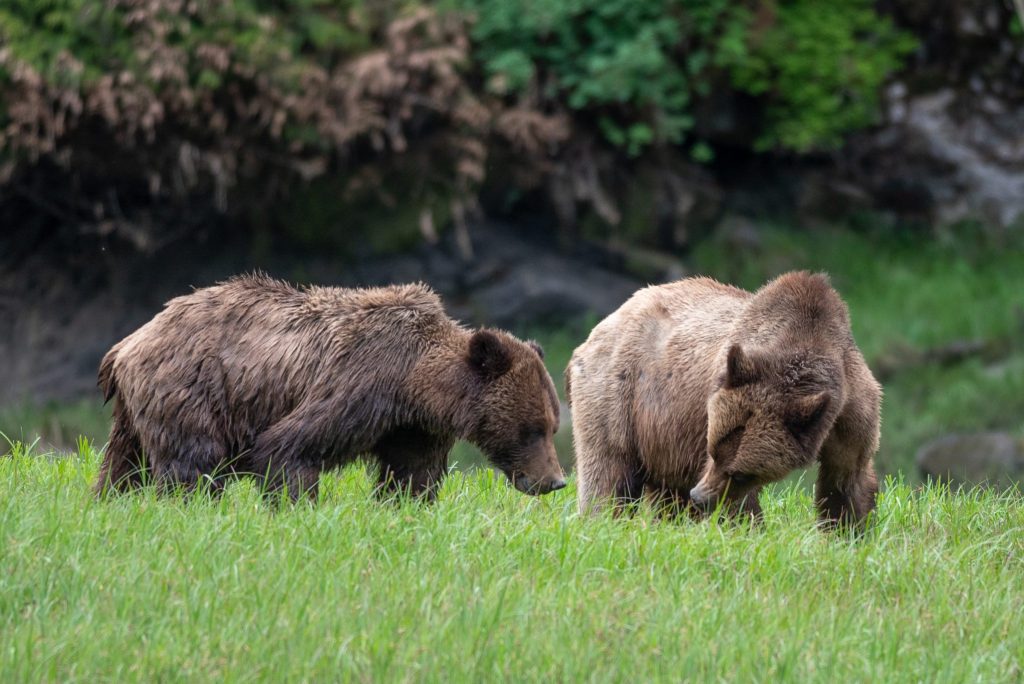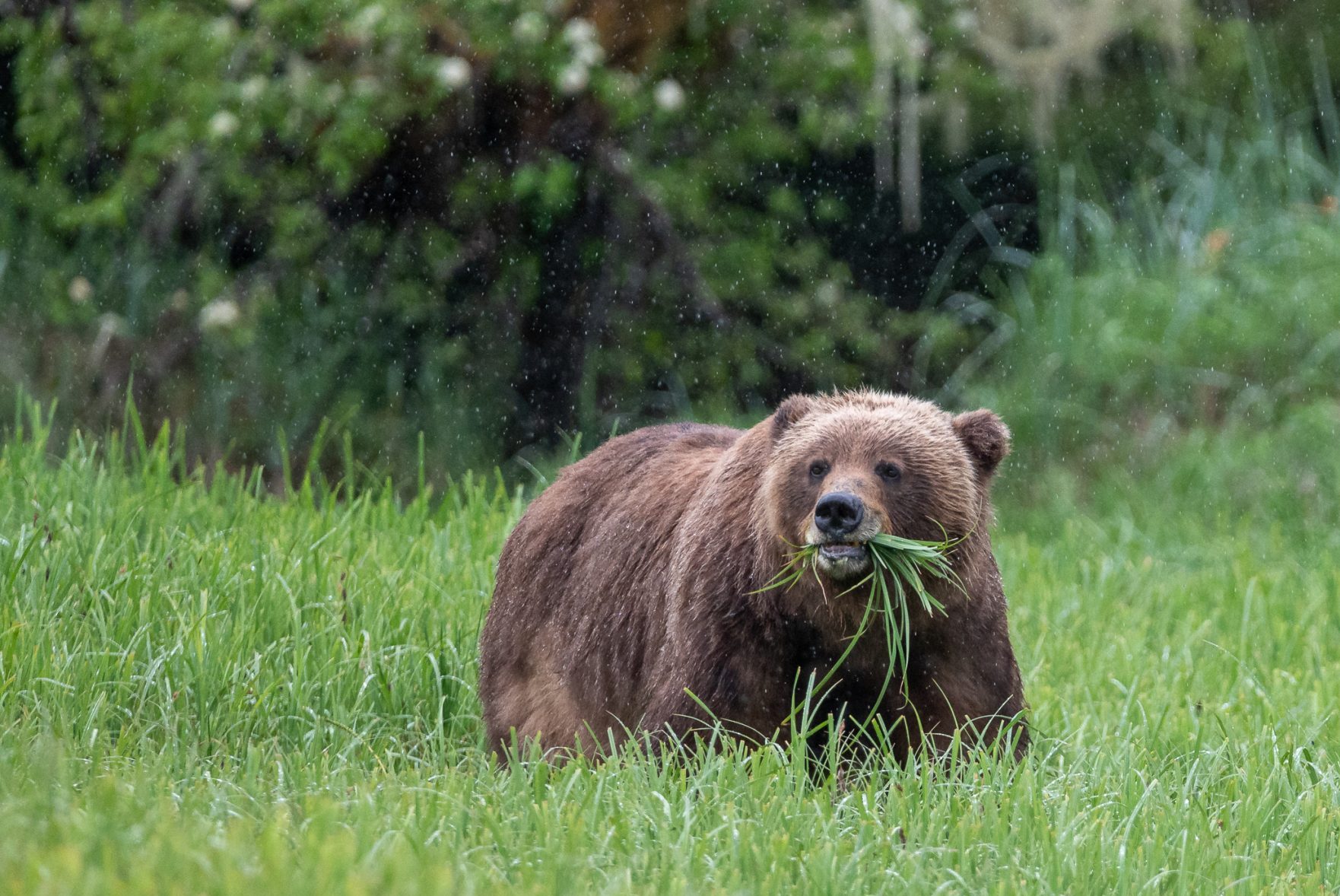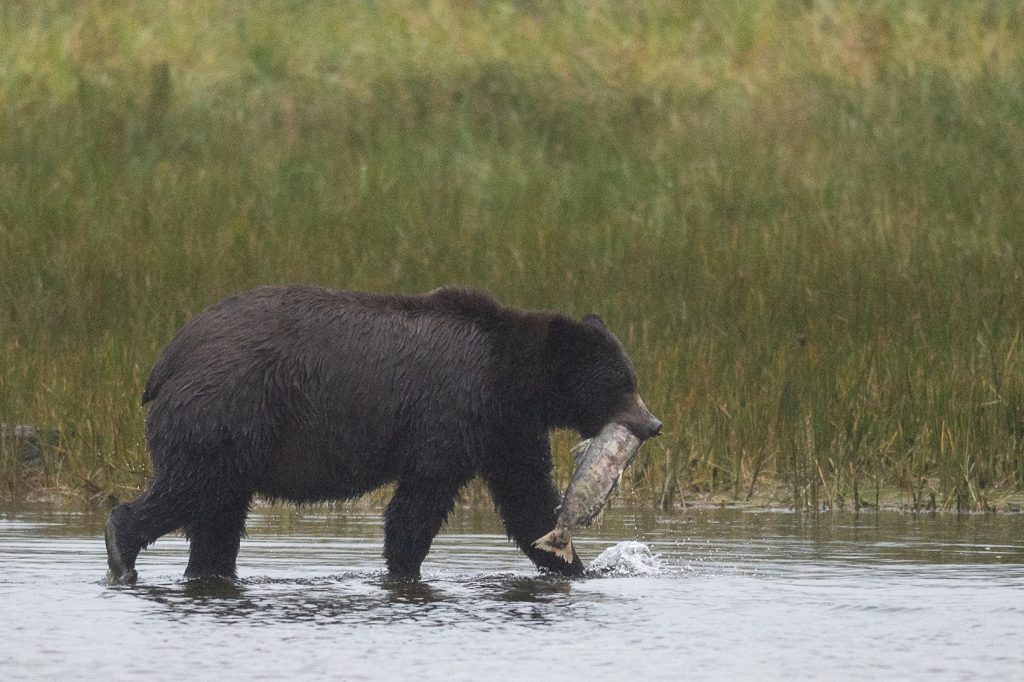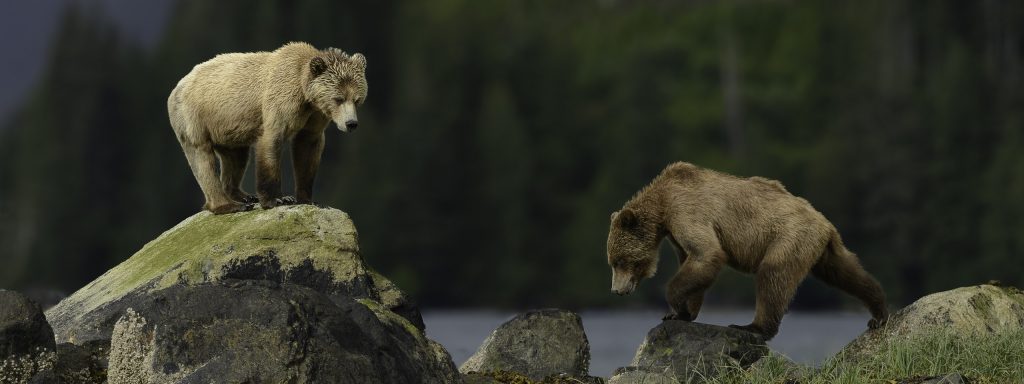
The Great Bear Rainforest is one of the premier locations globally for photographing grizzly bears in the wild. This rugged stretch of coast from northern Vancouver Island to the border with Alaska encompasses over 64,000 sqkm / 25,000 sqmi of Coastal Temperate Rainforest. Within this range, there are thousands of grizzly bears and black bears thriving in the inlets, estuaries, valleys, and river systems. In the spring time, grizzly bears forage along the nutrient rich coastlines. Small fish, crabs, sedges, and more make for much needed springtime calories. In the fall, they don’t go far, and take advantage of the rich salmon runs in one of the thousands of fish-bearing creeks, streams, or rivers.

Naturalist, Photographer, and Author, Edward Savage has been leading bear viewing expeditions in the Great Bear Rainforest for over a decade. Each year, he runs several Grizzly Bear Expeditions. See availability below.

GRIZZLY BEAR TOUR FAQ

The Great Bear Rainforest is a mostly intact span of coastal temperate rainforest that lies in between the north east tip of Vancouver Island (on the mainland) and the border with Alaska. One of the reasons it has stayed intact is because of its remoteness. To the west, is the open Pacific Ocean or the daunting Hecate Strait, and to the east, except for a few larger valley systems, is the daringly steep Coast Mountain Range. There are few roads that pierce their way through the mountains and out to the coast. It is thought that a bear, if so motivated, could walk from end to end of the rainforest without coming across many people.

This remoteness has kept the Great Bear Rainforest naturally protected from development and excessive industrial activity. It is hard to get to, let alone spend time in. And so, wildlife here reigns supreme. Grizzly bears, black bears, wolves, cougars, deer, Orca, Humpback Whales, Sea Lions, Seals, etc.. it is rich with life and one of the most stunning places anywhere on earth to spend some time.

Additionally, bear viewing has been going on in the Great Bear Rainforest for decades. Generations of grizzly bears in certain ranges have become accustomed to the silhouette of slow moving and small boats that show up for a time and then leave. They know, from generations of coexisting with these boats, that these strange vessels will not harm them, nor compete with them. It means bear viewing vessels and platforms become part of the background in the bears world.

If you're on a trip with me, chances are we'll see a good number of grizzly bears. In my preferred tour areas, I am personally familiar with the demographics of bears in the region, or a local contact is familiar. It means we're not just "looking around for bears" we are quite literally looking for known individual bears in known places that are within their range. Grizzly bears are surprisingly consistent in some sections of the coast and have quite small ranges. 

With that said, it's hard to say how many different grizzly bears we'll see on an expedition because wildlife is still wild and has its own schedule. Generally I will try to spend a good amount of time with a number of different individual bears, paying close attention to their behaviour and focusing on the more interesting / photogenic behaviours.

Generally, the grizzly bear tour groups are between 6 and 10 travelers. I try to keep the groups small so I can spend time with everyone on the tour. Also, most of the boats we'll use for bear viewing fit between 6 and 12 people. Viewing platforms are around 6 people per stand, with a few larger ones accommodating 12. We have a smaller footprint on land and silhouette on the water which also helps us with our wildlife goals.

Smaller groups ensure we're getting an exclusive experience.

Springtime in the Great Bear Rainforest brings about some varying weather. Generally, it is cool to warm, with morning being the coolest. There is often still snow on the mountains in May and June, and so overnight that cool air settles in the bottom of the inlets. But, we have long days, and plenty of time for things to warm up. I would expect a range of 5c / 40f to about 20c / 70f. 

As far as precipitation, we can expect it at some point. We'll likely get some rain, some wind, some sun, some fog, and maybe even a thunderstorm. Spring is a rapidly changing time in the Great Bear Rainforest and so we need to be ready for anything.

Fall grizzly bear tours in the Great Bear Rainforest are almost certain to have rain, and likely a lot of it. As the weather cools, a parade of low pressure systems roll in from the Pacific Ocean and collide with the tall coast mountains. This causes the clouds to dump their moisture on the Great Bear Rainforest. So, we'll likely have periods of rain. Air temperatures vary from ~5c/40f to about 20c/70f.

With that said, rain is crucial to our bear photography. There is nothing more emotive than a bear fishing for salmon in the rain. It is, in my opinion, your quintessential atmosphere for fall grizzly bear photography.

Lots of different species around in the spring. Especially attractive for migrating and nesting birds.

Spring

  • Mammals
    • Grizzly Bear
    • Black Bear
    • Coastal Wolf (rare)
    • Humpback Whale
    • Killer Whale
    • Pacific White Sided Dolphin
    • Harbour Porpoise
    • Dall's Porpoise
    • Sea Otter
    • Stellar Sea Lion
    • Harbour Seal
    • Red Squirrel
  • Birds
    • Bald Eagle
    • Great Blue Heron
    • Barrows Goldeneye
    • Harlequin Duck
    • Common Merganser
    • Red Necked Grebe
    • Marbled Murrelet
    • Common Loon
    • Red Throated Loon
    • Common Raven
    • Northwestern Crow
    • Stellar's Jay
    • Gulls (wide variety)
    • Red Breasted Sapsucker
    • Varied Thrush
    • Swainson's Thrush
    • American Robin
    • Pacific Wren
    • Yellow Warbler
    • Yellow-rumped Warbler
    • Rufous Hummingbird
    • Barn Swallow
    • Tree Swallow
      • *There are many more birds seen in the springtime, these are just a few that are quite common*

Lots of different species around in the spring. Especially attractive for migrating and nesting birds.

Fall

  • Mammals
    • Grizzly Bear
    • Black Bear
    • Coastal Wolf (rare)
    • Humpback Whale
    • Killer Whale
    • Pacific White Sided Dolphin
    • Harbour Porpoise
    • Dall's Porpoise
    • Sea Otter
    • Stellar Sea Lion
    • Harbour Seal
    • Red Squirrel
  • Birds
    • Bald Eagle
    • Great Blue Heron
    • Barrows Goldeneye
    • Harlequin Duck
    • Common Merganser
    • Red Necked Grebe
    • Marbled Murrelet
    • Common Loon
    • Red Throated Loon
    • Common Raven
    • Northwestern Crow
    • Gulls (wide variety)
    • Red Breasted Sapsucker
    • Varied Thrush
    • Swainson's Thrush
    • American Robin
    • Pacific Wren
    • Common Murre
    • Rhinoceros Auklet

The old saying "the best camera you have is the one you have with you" rings true on these trips. However, if you're interested in photography or have your own kit already, here is what camera equipment I would recommend for a grizzly bear photography tour in the great bear rainforest:

General suggestions:

  • Digital camera capable of decent low-light photography (good high-ISO performance)
  • Fast telephoto lens at least 300mm but 400mm+ is better.
  • Wider lens for landscape photography
  • Waterproof pack or case
  • Lots of memory cards and batteries (long days with lots of photos burns a lot of battery)

What's in my kit:

  • Nikon Z8
  • Nikon Z6
  • Nikon 100-400mm f4.5-5.6
  • Sigma 120-300mm f2.8
  • Nikon 24-120mm f4
  • Viltrox 16mm f1.8
  • Nikon 1.4x teleconverter (rarely used when the light is really good)
  • f-Stop Tilopa camera pack or a hard-case, similar to a pelican case
  • Lens clothes
  • Microfibre towel
  • Rain protection for camera and lens
  • Circular Polarizer for my 24-120mm f4 (only for rare and specific landscape shots, sometimes it is never used)

If you're thinking of joining a trip with me, or you already have booked, feel free to reach out to me for more camera specific advice. Happy to offer guidance to photo enthusiasts. Contact me here